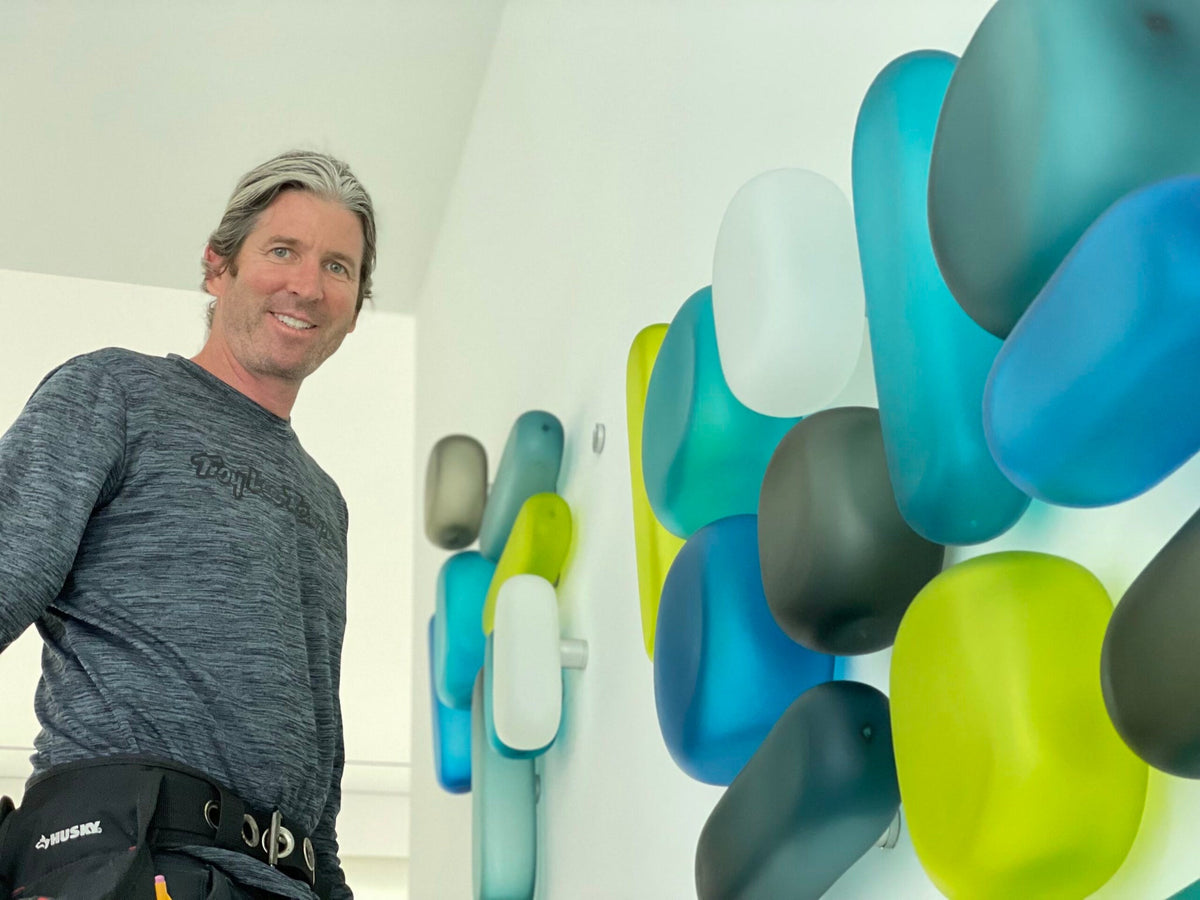
This story is part of Meet the Artists, a series in which we introduce the people behind the work on our walls in Park City and Sun Valley: how they work, what moves them, and how they got here.
From across the room, it looks like a riverbed: smooth stones of color scattered across a wall. Step closer and every stone turns out to be glass, blown by hand while it glowed, then sandblasted to a soft, satin finish. This is the work of Christopher Jeffries, a glass artist from Laguna Beach, California, and his Glass Rocks installation is part of both of our galleries: on a column at Gaia Sun Valley and on the wall beside our logo at Gaia on Main.
He has been blowing glass, he says, for more than 30 years. He runs Jeffries Glass in Laguna Beach with his wife, Jitka, and a team of glassblowers, and his hand-blown wall installations are made to fit the color and light of the room they live in.
“There’s something genuine about meeting the person that ends up living with the piece that you made… there’s something really neat about that.”
Christopher Jeffries
Where it began: a glass class in Bakersfield
Christopher grew up in Bakersfield, California, in a home full of art. “Art was a big part of my childhood… my mom was an oil painter, and my parents really nurtured the arts at home,” he told the Association of Clay and Glass Artists of California.
In his senior year of high school, he told the Association of Clay and Glass Artists of California, he took a glassblowing class at Bakersfield Junior College. “I got bit by the glass bug!” he said. In a studio video he described the moment: “I knew I was drawn to the arts, but I wanted to figure out what that it was, what material I really wanted to continue to pursue and work with. And so I took a glass class and it felt natural. It was something that I was not only drawn to, but it felt right from the get-go.”
He went on to earn a fine art degree with an emphasis in glass at California State University, Chico. “From that point on I was enamored by glass,” he said in a 2011 film about his work. “It really had captured me.” He also studied sculpture and design at the Lorenzo de’ Medici institute in Florence, Italy.
Czech Republic and Seattle
Then came the Czech Republic, a country with a long tradition of glassmaking. “My dream was to live and work in Czech Republic,” he recalled. “I had a one-way ticket to Czech and brought my tools. I think I had not even $1,000 to my name and just flew over there.” He worked with the Czech glass master Igor Müller. “Igor was nice enough to let me hang out and basically sleep on his floor at the shop. I kind of started there from the bottom up as well, and that was definitely one of the highlights of my life.”
It was in the Czech Republic that he met his wife, Jitka. “While I was living in Czech Republic I met my wife,” he said, “so I have to say that tops it all.”
In Seattle, Christopher apprenticed with Dale Chihuly’s Boat House studio, where production meant big teams and high volume. “Working with Dale showed me how important teamwork was,” he said. “All the projects we worked on required everyone to work together in large teams. Working for Chihuly really inspired me to start working on larger scale projects.” He has also taught at the Corning Museum of Glass.
Glass is a team sport
Back in Laguna Beach, Christopher started Jeffries Glass, and he and Jitka run it together to this day. She focuses on design, creating renderings and building each project. He blows the glass. “Glass blowing is a team process for me,” he says. “It allows me to work on a larger scale. I feel very lucky to have a great team of glassblowers working with me.”
In the 2011 film he explained what that teamwork asks of everyone in the hot shop: “So it takes a lot of teamwork and a lot of timing and a lot of understanding your assistants’ knowledge and them understanding you and what you need at what particular time.” Over the years, the people at the furnace become more than coworkers. “After you work with someone for a long time… you kind of anticipate what they need. You work well together and you’re eating the same food at lunch. You’re hanging out all the time. You’re sharing stories. … They become part of your family in a way.”
How he works: honey, cork and sand
Every piece starts at the furnace, with molten glass that, in his words, closely resembles the consistency of honey. Colored glass is heated and dropped onto a clear bubble. The bubble is blown and shaped with tools of wood, cork and steel, then placed in an annealing oven to cool slowly. After that the glass is cold worked and sandblasted. “We sandblast the glass with a very fine silica sand,” he explains, “giving the surface of the glass a soft satin finish.”
He is not afraid to take chances along the way. “I like to take risks and push myself in new ways so I don’t ever get too comfortable,” he says. “I am not afraid to fail; some of my best ideas have come from my failures.”
Off the pedestal, onto the wall
For years Christopher made vessels and sculptural forms. Then he moved his glass to the wall. “Most of the work that I’ve been making prior to the wall installation work have been vessels or they could have been sculptural pieces, but they’re more designed and made for a table or for a niche in a home to sit on something,” he said, “and these actually being mounted on the wall allows me to work on a larger scale and it also allows me to fill a space in a different way.”
Each installation is planned for one particular room. It begins with a sketch and a color palette. The client sees a rendering of the piece in their own space and, once they approve it, each piece is mapped on a paper template before production and installation. “It is really important to me when I come into a location and look at a space to figure out what colors are going to work within that space,” he says, “and what color the person that owns the home or the person that owns the building wants to be surrounded by.” The goal, in his words, is to “get a good idea of what colors they want to live within for the rest of their lives.”
That is also how he works at art fairs. “We’ll have anywhere between one to three pieces in the booth that might be set on a pedestal,” he said in a 2024 podcast interview, “but everything else is custom made for the client and for the space that we’re going to install it in.” In 2020 he installed an Island Series wall in a private home in Park City.
The series at GAIA
Christopher’s wall works come in series, and four of them are on our site. Every one is available through both Gaia on Main in Park City and Gaia Sun Valley in Ketchum.
Rock Series. The series behind our Glass Rocks installation was inspired by the riverbeds along the Russian River in Northern California. “Using color, I can create pathways to lead the viewers’ eye,” he writes, “and the empty space becomes the simple beauty in the overall composition.”

Island Series. Inspired by island chains in the Pacific, these forms are flattened with cork paddles, joined in the center to make a hole, and mounted on the wall. He usually makes them in opaque colors, mostly white and a pigeon gray, and in other colors on request.

Intersection Series. Long blown tubes, cut and sandblasted, cross one another on the wall. The series, he writes, is “inspired by the wonders of human interaction. When lines and personalities come together, intersections form and relationships take place.”

Geometric Series. This one asks you to step back. In his words, it “forces us to step back and look at it from a distance,” and “by changing one color or the direction in which it comes off the wall will change the whole design.”

See Christopher Jeffries’ work available through both of our galleries →
Recognition
At the 2012 Sawdust Art Festival in Laguna Beach, his fellow artists awarded him first place in blown glass in the festival’s peer awards. He exhibits at the Festival of Arts in Laguna Beach and at the La Quinta Art Celebration, where he took part again in 2026.
For Christopher, the shows are about the people. “It’s super-rewarding going to these shows and meeting clients and collectors,” he told the Coachella Valley Independent in 2026. “It’s really an honor to have our artwork in anybody’s home.”
Christopher Jeffries’ work at GAIA
At GAIA, Christopher’s glass is part of the galleries themselves: his Glass Rocks installation greets you on the column at Gaia Sun Valley and on the wall beside our logo at Gaia on Main. Our site shows four of his series, but everything in Christopher’s collection is available through both of our galleries.
Because almost every installation is made for a particular wall, the best place to start is a conversation. If you’d love a piece of hand-blown glass designed for your home, contact us for a private consultation, or visit us at either gallery. Plan your visit →
Questions about a piece? Contact us at either of our galleries: Park City 435-731-8376 · Sun Valley 208-973-0137 · Contact us online →
Available through both of our galleries
Gaia on Main, 314 Main Street, Park City, Utah
Gaia Sun Valley, 659 Sun Valley Road, Ketchum, Idaho
Sources
- Christopher Jeffries, “Meet Christopher” (jeffriesglass.com)
- Jeffries Glass, “Wall Installations” and series pages (jeffriesglass.com)
- Association of Clay and Glass Artists of California, newsletter interview with Christopher Jeffries (June 2024)
- ShoutoutLA, “Meet Christopher Jeffries” (June 24, 2024)
- Melissa Daniels, Coachella Valley Independent, “Connecting With Creators” (February 9, 2026)
- Eric Minh Swenson and f.64 Productions, “Christopher Jeffries: The Art of Glass” (YouTube, May 30, 2011)
- Jeffries Glass, “Hot Shop Process – Artist Intro: Christopher Jeffries” (YouTube, October 2, 2020)
- Jeffries Glass, “Rock Wall Installation – Laguna Beach, CA” (YouTube, October 2, 2020)
- Instagram, @jeffriesglass (video on his Czech Republic years and Seattle)
- Independent Artist Podcast, “Paying Your Dues / Christopher Jeffries” (February 19, 2024)
- Daily Pilot, Sawdust Art Festival peer awards (September 27, 2012)